
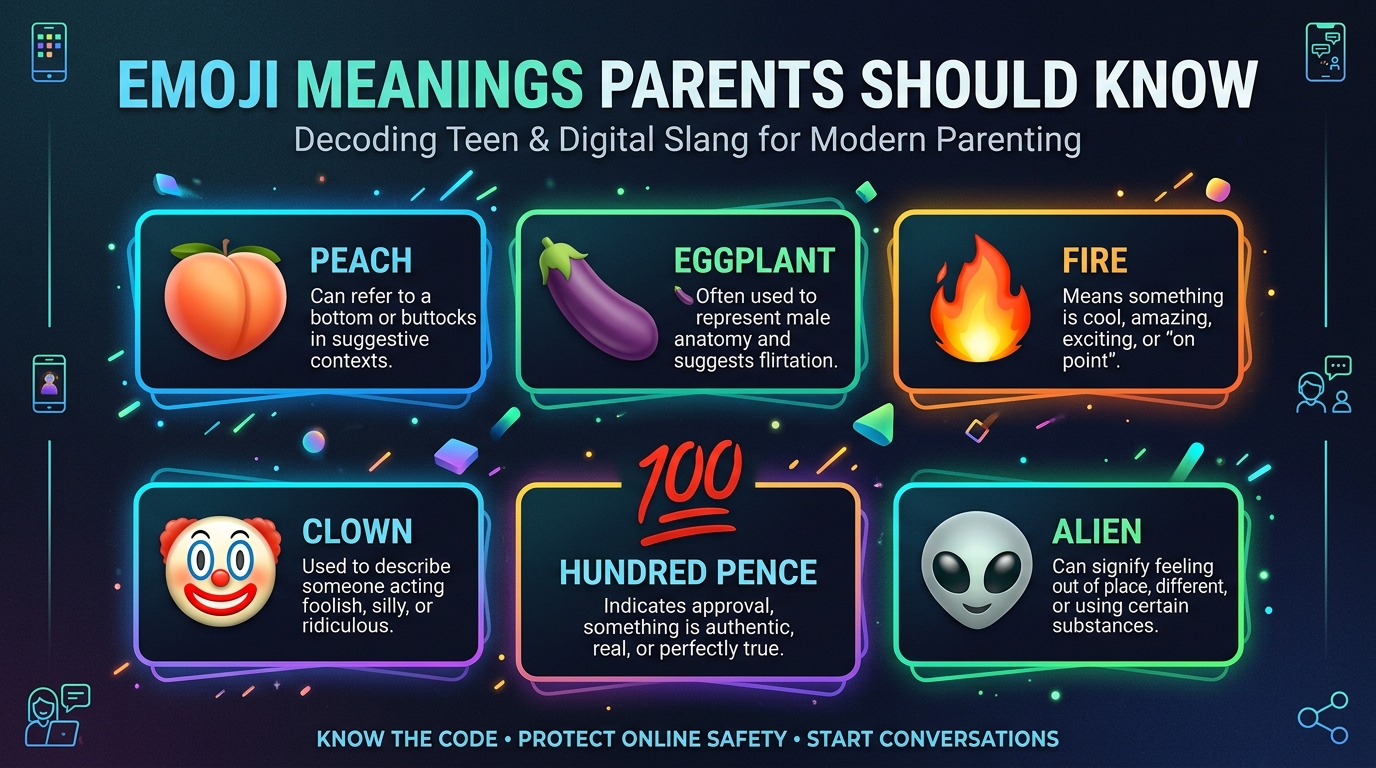
Emojis may look simple, but they have transformed the way we communicate online. One emoji can convey an emotion, substitute for a word, add a touch of sarcasm, or take on a different meaning depending on the conversation. For kids and teens, emojis are a regular part of their digital interactions. They show up in texts, Snapchat chats, Instagram messages, TikTok comments, WhatsApp groups, gaming chats, and more. Some meanings are easy to understand, while others come from internet trends, memes, Gen-Z slang, or inside jokes. Because of this, emoji slang can be tricky for parents to navigate.
An emoji that seems innocent might carry a different connotation in a particular context. At the same time, it’s essential for parents not to jump to conclusions that every unusual emoji signifies something secretive or risky.
Parents should focus on the context, patterns, and history of conversations when it comes to using emojis, instead of judging a single emoji.
This guide explains common emojis, how Gen-Z uses them, combinations, platform differences, and what parents should know about digital communication.
What Is Emoji Slang?
Emoji slang is the use of emojis to communicate meanings beyond their traditional or literal definitions.
For example, the skull emoji 💀 literally represents a skull, but in online conversations it is commonly used to express extreme laughter, embarrassment, disbelief, or a reaction such as “I can’t believe this.”
Similarly, the eyes emoji 👀 can literally represent eyes, but it may also communicate curiosity, interest, suspicion, or “I’m watching.”
Emoji slang can develop through:
- Social media trends
- Memes
- Teen and Gen-Z culture
- Online communities
- Dating conversations
- Gaming communities
- Platform-specific habits
- Emoji combinations
The important thing to remember is that emoji meanings are not fixed. The same symbol can have different meanings between people, age groups, platforms, and conversations.
Literal Meaning vs. Slang Meaning
| Emoji | Literal Meaning | Common Online/Slang Meaning |
| 💀 | Skull | “That is hilarious” / “I’m dead” |
| 😭 | Crying | Extreme laughter or strong emotion |
| 👀 | Eyes | Curious, interested, watching |
| 🫠 | Melting face | Embarrassed, overwhelmed |
| 🐐 | Goat | Greatest of all time |
| 🤡 | Clown | Someone acting foolish |
| 💅 | Nail polish | Confidence, attitude, self-expression |
| 🗿 | Moai statue | Deadpan or unbothered reaction |
| 🧢 | Cap | Lie or exaggeration |
| 🔥 | Fire | Excellent, attractive, exciting |
How Emoji Meanings Change With Context
One of the biggest mistakes parents can make is assuming that an emoji has only one meaning.
Consider 💀.
Someone might write:
“That video was so funny 💀”
Here, the emoji probably communicates laughter or amusement.
But:
“The character died 💀”
Here, the same emoji can have a much more literal meaning.
The context changes the interpretation.
Before assuming an emoji has a hidden meaning, consider:
- Who sent it?
- Who received it?
- What was being discussed?
- What emojis were used with it?
- Which platform was being used?
- Is this a common joke among friends?
- Does the same pattern appear repeatedly?
More Examples
🔥
- “This song is 🔥” → excellent or exciting
- “You look 🔥” → attractive
- “The building is 🔥” → literal fire
👀
- “I’m watching the movie 👀” → watching
- “She has a new boyfriend 👀” → curiosity or gossip
- “Send me the details 👀” → interested
😭
- “I can’t stop laughing 😭” → extreme laughter
- “I miss you 😭” → genuine sadness
- “This is so cute 😭” → overwhelming emotion
This is why a single emoji should rarely be treated as evidence of anything serious.
Complete Emoji Slang Meaning Chart
The following chart provides a quick reference to common emojis and possible meanings in online conversations.
Reaction and Emotion Emojis
| Emoji | Common Slang Meaning | Example Context |
| 😂 | Laughing | Funny message |
| 🤣 | Very funny | Strong laughter |
| 💀 | “I’m dead” / extremely funny | Meme or joke |
| 😭 | Strong emotion / laughing | Funny or emotional message |
| 🥹 | Touched, emotional, pleading | Cute or emotional moment |
| 🫠 | Overwhelmed or embarrassed | Awkward situation |
| 🙃 | Sarcasm or frustration | Difficult situation |
| 😵💫 | Confusion or emotional chaos | Overwhelming situation |
| 🤡 | Foolish or embarrassing | Someone made a bad decision |
| 🗿 | Deadpan or unbothered | Reaction meme |
| 🫡 | Respect, agreement, acknowledgment | “Got it” |
| 😭 | Overwhelming laughter or sadness | Depends on context |
| 😏 | Smirk, confidence, possible flirting | Dating or joking |
| 🥵 | Very hot, intense, or attractive | Weather, exercise, flirting |
| 🤯 | Shock or amazement | Unexpected news |
| 😮💨 | Relief, frustration, exhaustion | Emotional response |
| 😐 | Neutral or unimpressed | Dry reaction |
| 😶 | Speechless or emotionally quiet | Awkward conversation |
| 🤨 | Suspicion | Questioning something |
| 😬 | Awkwardness | Uncomfortable situation |
Gen-Z and Internet Culture Emojis
| Emoji | Possible Meaning |
| 💀 | Extremely funny / disbelief |
| 🗿 | Unbothered / deadpan |
| 🧢 | Lie / false statement |
| 🐐 | Greatest of all time |
| 🤡 | Foolish behavior |
| 💅 | Confidence or attitude |
| 👀 | Interest or curiosity |
| 🫶 | Affection or appreciation |
| ✨ | Emphasis, excitement, aesthetic |
| 🚩 | Red flag / warning |
| 🫠 | Embarrassment or overwhelm |
| 😭 | Extreme emotion |
| 🔥 | Excellent or attractive |
| 🥶 | Impressive, intense, or cold |
| 🗿 | Dry or emotionless reaction |
| 🧍 | Awkward silence or disbelief |
| 🫣 | Shy, embarrassed, or watching nervously |
| 🧚 | Playful or ironic internet persona |
| 🐍 | Fake or untrustworthy person |
| 🐀 | Snitch or annoying person in some contexts |
| 🫥 | Feeling invisible or ignored |
Dating and Flirting Emojis
Some emojis can communicate attraction, affection, or romantic interest. However, these meanings are highly dependent on the relationship and conversation.
| Emoji | Possible Meaning |
| ❤️ | Love or strong affection |
| 💕 | Romantic affection |
| 💗 | Affection or growing feelings |
| 🤍 | Love, support, affection |
| 💋 | Kiss or flirting |
| 😏 | Flirting or suggestive tone |
| 😈 | Playful or suggestive behavior |
| 🔥 | Attractive or impressive |
| 🥵 | Attraction or intensity |
| 👀 | Interest or curiosity |
| 💍 | Commitment or marriage |
| 🥰 | Romantic affection |
| 😘 | Kiss/affection |
| 💌 | Romantic message |
| 🌹 | Romance or affection |
A heart emoji between close friends does not necessarily indicate a romantic relationship. Context matters.
Emoji Slang Related to Drugs and Substance Use
Some emojis are sometimes used as references to drugs or substances in online conversations. However, these meanings are not universal.
| Emoji | Possible Slang Reference |
| 🍃 | Cannabis or weed |
| 🌿 | Cannabis |
| 💊 | Pills or medication |
| ❄️ | Possible cocaine reference |
| 🍄 | Psychedelic mushrooms |
| 💉 | Injection or drugs |
| 🚬 | Smoking |
| 💨 | Smoke, vaping, or “getting high” depending on context |
| 🧃 | Possible reference to a drug-containing drink in some contexts |
Parents should not assume that seeing one of these emojis means a child is using drugs.
For example, 🍄 could simply refer to mushrooms, 🍃 could refer to plants or nature, and 💊 could refer to legitimate medicine.
Look for the conversation around the emoji, repeated patterns, and other relevant context.
Emojis With Sexual or Adult Meanings
Some emojis have developed sexual or adult interpretations in online culture.
| Emoji | Possible Adult/Slang Meaning |
| 🍑 | Buttocks |
| 🍆 | Penis / male genitalia |
| 👅 | Sexual or suggestive context |
| 💦 | Sexual or suggestive context |
| 😈 | Suggestive or flirtatious |
| 🔥 | Attraction |
| 🥵 | Sexual attraction or intensity |
| 🛏️ | Sex or hooking up in some contexts |
| 💋 | Kissing or sexual flirting |
Again, context is critical.
For example, 🍑 may simply refer to a peach, 🍆 may literally refer to an eggplant, and 💦 may refer to water.
Parents should look at the complete conversation instead of interpreting a single symbol.
Emojis Used for Bullying and Insults
Emojis can also be used to mock, shame, exclude, or insult other people.
| Emoji | Possible Meaning |
| 🤡 | Calling someone foolish or embarrassing |
| 🐍 | Calling someone fake or untrustworthy |
| 🐀 | Calling someone a snitch |
| 💀 | Mocking someone or laughing at them |
| 👎 | Disapproval or insult |
| 🤢 | Disgust |
| 🗑️ | Calling someone “trash” |
| 🚮 | Dismissal or insulting someone |
| 🤮 | Strong disgust |
| 😂 | Can be used to mock someone |
Cyberbullying may not always involve direct insults. A group of people repeatedly using mocking emojis toward one person can also contribute to harassment or exclusion.
Parents should pay attention to patterns such as:
- Repeated mocking
- Group exclusion
- Public humiliation
- Threatening messages
- Repeated negative reactions
- Sharing embarrassing content
Emojis Related to Emotional Distress
Some emojis can appear in conversations about sadness, loneliness, stress, or emotional pain.
| Emoji | Possible Emotional Meaning |
| 🖤 | Sadness or emotional pain |
| 😔 | Sadness |
| 💔 | Heartbreak |
| 🥀 | Loss, sadness, or emotional pain |
| 😵 | Overwhelmed |
| 😶 | Feeling unable to speak |
| 🫥 | Feeling invisible or ignored |
| 😞 | Disappointment or sadness |
| 😣 | Distress or frustration |
| 🔪 | Can be associated with self-harm in some contexts |
| 🩸 | Can be associated with injury or self-harm in concerning contexts |
These emojis should never be used alone to diagnose someone’s mental health.
If a child repeatedly expresses distress, talks about hurting themselves, or shows major behavioral changes, parents should focus on supportive communication and seek appropriate professional help when needed.
Emojis Used for Secrecy and Privacy
Some emojis may be used when people want to communicate privately.
| Emoji | Possible Meaning |
| 🤫 | Keep it secret |
| 🔒 | Private / locked |
| 👀 | Watching or checking |
| 🕶️ | Under the radar |
| 🔕 | Don’t disturb / don’t talk |
| 📵 | No phone / stay offline |
| 🚪 | Leaving or going somewhere |
| 🤐 | Don’t tell anyone |
However, privacy is not automatically suspicious.
Teenagers may use 🤫 because they are planning a surprise birthday party, discussing a joke, or sharing ordinary private information.
The meaning depends on the conversation.
Common Emoji Combinations and Their Meanings
Individual emojis are only part of modern digital communication. People also combine emojis to create a particular tone or idea.
| Combination | Possible Meaning |
| 💀😭 | Extremely funny or overwhelming |
| 😂💀 | Very funny |
| 👀🫣 | Curious but shy |
| 🚩🚩 | Major red flag |
| ❤️🔥 | Attraction or admiration |
| 🧢❌ | “No cap” / not lying |
| 🤫👀 | Keep it secret / watching quietly |
| 🫶❤️ | Strong affection |
| 💋❤️ | Romantic affection |
| 🍃💨 | May reference smoking/vaping depending on context |
| 👀📸 | Possible request or interest in photos |
| 🔒❤️ | Private or committed relationship |
| 😭💀 | Extreme reaction to something funny |
| 🥵🔥 | Very attractive or intense |
| 🤡💀 | Someone behaved foolishly |
These combinations are possible interpretations, not universal codes.
Gen-Z Slang and Emoji Dictionary
Emoji slang often appears alongside abbreviations and internet slang. Parents who understand both can better understand the overall conversation.
| Slang | Meaning |
| FR | For real |
| FRFR | For real, for real |
| NGL | Not gonna lie |
| TBH | To be honest |
| IMO | In my opinion |
| IYKYK | If you know, you know |
| WYA | Where you at? |
| WYLL | What you look like? |
| IDK | I don’t know |
| RN | Right now |
| LOL | Laughing out loud |
| LMAO | Laughing very hard |
| BTW | By the way |
| DM | Direct message |
| PM | Private message |
| BRB | Be right back |
| TTYL | Talk to you later |
| Cap | A lie |
| No cap | No lie / seriously |
| Bet | Okay / agreed |
| Ate | Did something very well |
| W | Win / positive outcome |
| L | Loss / negative outcome |
| Sus | Suspicious |
| Rizz | Romantic charm |
| GOAT | Greatest of all time |
| ICK | Something that suddenly feels unattractive |
| Mid | Average or unimpressive |
| Slay | Did something extremely well |
| Flex | Show off |
| Ghost | Stop responding or disappear from communication |
Slang changes quickly, and the same term can have different meanings in different communities. Parents should treat slang dictionaries as a starting point rather than a perfect translation tool.
Traditional Emoji Meaning vs. Modern Online Meaning
Some emojis are especially confusing because their modern online use may differ from what older users expect.
| Emoji | Traditional Interpretation | Common Modern Use |
| 💀 | Death | “I’m dead” / hilarious |
| 😭 | Crying | Extreme laughter or emotion |
| 🙃 | Upside-down smile | Sarcasm or frustration |
| 💅 | Nail polish | Confidence or attitude |
| 🗿 | Statue | Deadpan/unbothered |
| 🐐 | Goat | Greatest of all time |
| 🤡 | Clown | Someone behaving foolishly |
| 👀 | Eyes | Interest or curiosity |
| 🧢 | Cap | Lie |
| 🫠 | Melting | Embarrassment or overwhelm |
This is one reason parents may misunderstand a child’s message. The child may be using an emoji in a humorous or cultural way rather than its literal dictionary definition.
Emoji Meanings on Different Platforms
Emoji usage can vary between platforms because each community develops its own communication habits.
Emoji Meanings on Snapchat
Snapchat conversations often use short messages, reactions, pictures, and disappearing content.
Common emojis may be used to communicate:
- Interest
- Friendship
- Reactions
- Flirting
- Humor
- Streak-related communication
A Snapchat emoji should be interpreted within the surrounding conversation rather than treated as a universal code.
Emoji Meanings on TikTok
TikTok comments often combine emojis with memes, slang, and jokes.
You may see combinations such as:
- 💀 for something hilarious
- 😭 for extreme reaction
- 👀 for curiosity
- 🔥 for something impressive
- 🗿 for deadpan humor
- 🚩 for warning or criticism
TikTok slang changes quickly, so older meanings may become outdated.
Emoji Meanings on Instagram
Instagram emojis commonly appear in:
- DMs
- Comments
- Stories
- Reactions
- Dating conversations
Hearts, eyes, fire, kisses, and laughing emojis can carry different meanings depending on the relationship between the people involved.
Emoji Meanings on WhatsApp
WhatsApp is used for both casual and family conversations, so emoji meanings vary greatly.
The same ❤️ may mean romantic love in one conversation and family affection in another.
Emoji Meanings on Discord and Gaming Chats
Gaming communities often use emojis for:
- Reactions
- Humor
- Celebration
- Sarcasm
- Memes
- Community-specific jokes
A symbol that appears suspicious to an outsider may simply be a gaming meme.
How to Tell If an Emoji Has a Hidden Meaning
Parents do not need to memorize every emoji on the internet.
Instead, look for patterns.
1. Look at the Conversation
What are people discussing before and after the emoji?
2. Look at Repeated Use
One unusual emoji is rarely meaningful by itself. Repeated patterns can provide more context.
3. Look at Emoji Combinations
Multiple emojis may communicate a more specific message than one symbol.
4. Consider the Platform
A symbol used in a gaming server may have a different meaning from the same symbol in a dating conversation.
5. Consider the Relationship
Friends, siblings, romantic partners, and strangers may use the same emoji differently.
6. Look for Behavioral Changes
Digital communication becomes more concerning when it occurs alongside significant changes such as:
- Sudden withdrawal
- Fear of showing messages
- Major mood changes
- Repeated bullying
- Unwanted contact
- Pressure to send private images
- Threats or manipulation
The goal is not to spy on every message. It is to understand whether there is a broader pattern that needs attention.
Emojis Parents Should Pay Particular Attention To
Certain categories deserve additional awareness, but none should automatically be considered proof of harmful behavior.
Sexual or suggestive emojis
Look at the conversation and whether someone is pressuring the child to send sexual or private content.
Drug-related emojis
Consider whether the conversation also discusses buying, selling, using, or obtaining substances.
Bullying emojis
Look for repeated insults, group harassment, humiliation, or exclusion.
Distress-related emojis
Look for repeated expressions of hopelessness, sadness, self-harm, or emotional crisis.
Secrecy-related emojis
Ask whether secrecy is ordinary privacy or part of a concerning pattern involving strangers, threats, or manipulation.
What Parents Should NOT Do
Understanding emoji slang is useful, but how parents respond is even more important.
Don’t Panic Over One Emoji
A single 🍄 does not mean someone is using drugs.
A single 🔪 does not automatically mean self-harm.
A single ❤️ does not prove a romantic relationship.
Don’t Assume Every Slang Word Is Dangerous
Young people use slang for humor, identity, friendship, and social connection.
Don’t Accuse Your Child
Instead of:
“Why are you using these secret emojis?”
Try:
“I noticed people use emojis differently now. What does this one mean to you?”
Don’t Ignore Serious Patterns
At the same time, parents should not dismiss repeated bullying, threats, sexual pressure, or signs of emotional distress.
Don’t Treat Monitoring as a Replacement for Parenting
Technology can provide information, but communication, trust, and guidance remain essential.
How to Talk to Your Child About Emoji Slang
A calm conversation can help parents understand online communication without making children feel attacked.
Try asking:
- “What does that emoji mean to you?”
- “Do people at school use that emoji differently?”
- “Are there any emojis adults usually misunderstand?”
- “What slang do people use on TikTok?”
- “Have you ever received a message that made you uncomfortable?”
- “What would you do if someone asked you for a private photo?”
- “Do you know how to block or report someone?”
- “Who would you tell if something online made you feel unsafe?”
The goal is to make your child feel comfortable asking for help.
A child who expects punishment for every mistake may hide problems. A child who expects support is more likely to report bullying, inappropriate contact, or pressure.
Setting Healthy Digital Expectations
Parents can establish clear expectations around online communication.
Discuss:
Respect
Jokes should not become harassment or humiliation.
Privacy
Children should understand that private images can be copied or shared without permission.
Consent
No one should pressure them to send intimate images or personal information.
Stranger Contact
Children should know that online identities may not always be what they appear to be.
Reporting
Teach children how to block and report accounts when necessary.
Asking for Help
Make it clear that coming to a parent after an uncomfortable online experience will not automatically result in punishment.
The Role of Parental Monitoring and Digital Awareness
Digital awareness tools can sometimes help parents understand their children’s online environment, especially when children are young or facing specific online risks.
However, responsible monitoring should focus on safety and communication rather than constant surveillance.
Parents may use age-appropriate digital safety tools to help understand:
- Which platforms a child uses
- Whether online interactions appear concerning
- Whether bullying is occurring
- Whether strangers are attempting inappropriate contact
- Whether communication patterns have changed
If a parental monitoring solution is used, parents should consider the child’s age, maturity, privacy, and applicable laws.
Monitoring should complement parenting rather than replace it.
TheOneSpy and Emoji Awareness
Parental monitoring solutions such as TheOneSpy may be used by parents who want additional visibility into a child’s digital activity.
When used responsibly, such tools can help parents understand communication patterns and provide context around online activity.
The important principle is balance.
A monitoring tool should not become an excuse to avoid talking with a child. Parents should use information as a starting point for supportive conversations rather than immediately assuming the worst.
When Should Parents Take Action?
An unusual emoji alone usually does not require immediate intervention.
Parents should pay more attention when multiple warning signs appear together.
For example:
- Repeated bullying messages
- Threats
- Sexual pressure
- Requests for private images
- Contact with unknown adults
- Drug-related conversations combined with other evidence
- Repeated self-harm references
- Sudden emotional or behavioral changes
- Attempts to isolate the child
- Blackmail or threats to expose private information
If a child appears to be in immediate danger or is talking about harming themselves, treat the situation seriously and seek appropriate professional or emergency support.
Frequently Asked Questions About Emoji Slang.
What emojis should parents know?
Parents may want to become familiar with common reaction emojis, Gen-Z slang emojis, dating-related symbols, bullying-related emojis, secrecy emojis, and emojis that can have adult or substance-related interpretations.
Do emoji meanings change over time?
Yes. Internet culture changes quickly, and the meaning or popularity of an emoji can shift between generations and online communities.
Can one emoji have multiple meanings?
Absolutely. A single emoji can have a literal meaning, emotional meaning, humorous meaning, slang meaning, or adult meaning depending on the context.
What emojis do teenagers use for flirting?
Common examples can include ❤️, 💕, 😏, 😘, 💋, 🔥, 🥵, and 👀. However, the same emojis can also be used casually between friends.
How can parents understand teen emoji slang?
Parents can learn common meanings, ask children directly about unfamiliar symbols, pay attention to context, and avoid assuming that one emoji proves something serious.
Final Thoughts
Emojis are a normal part of modern digital communication. On their own, they are not necessarily dangerous or concerning. The real challenge for parents is that online language changes quickly, and the meaning of an emoji can vary depending on the conversation, platform, and people involved.
An emoji that has a simple meaning in a dictionary may have a completely different meaning in a TikTok comment, private message, meme, or gaming chat.
Parents do not need to memorize every emoji. Instead, focus on understanding the context and overall conversation.
- Learn the most common emoji slang.
- Consider the context before making assumptions.
- Pay attention to emoji combinations.
- Consider which platform is being used.
- Look for repeated or concerning patterns.
- Talk openly with your child about online communication.
- Teach children about digital safety and responsible sharing.
- Take repeated warning signs seriously.
- Respect your child’s age-appropriate privacy.
Most importantly, never assume that one emoji proves that a child is doing something wrong. Instead of asking only, “What does this emoji mean?” consider asking, “What does this emoji mean in this particular conversation and context?”
This approach can help parents understand their children’s digital world without creating unnecessary fear or damaging trust. Emoji slang will continue to evolve, but good digital parenting remains focused on three things: staying informed, staying calm, and staying connected.