
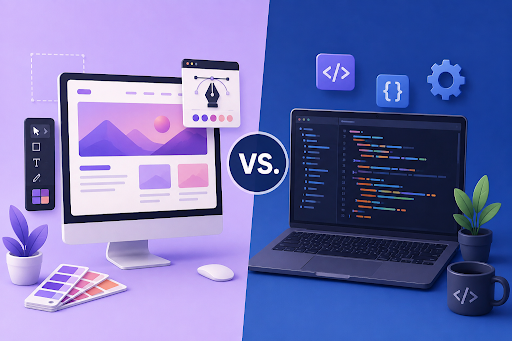
When I first started exploring websites, I thought web design and web development were interchangeable. However, I quickly learned that while they work together, they serve completely different purposes.
Knowing the difference between a web design company and a web development service company before building a website is crucial, as it ensures accurate budgeting and guarantees your site’s proper functioning. Let’s dive into what each role involves so you can make the best choice for your project.
What Is Web Design?
A web designer focuses on creating an engaging visual experience for the users. It is the process of planning the layout, design, and colour schemes to improve the overall user experience of a website. Web designers need to understand business goals and the target audience to align the design with the client’s vision and also resonate with users.
Web designers need to pay attention to the website’s aesthetic. The key responsibilities of a web designer include:
- Wireframing: This includes drawing basic structural blueprints of web pages before working on the actual design. Wireframes help designers understand the website’s structure and the user flow in the project.
- Layout Creation: This builds the visual appeal for users. It includes organizing text and images for easy reading and white space to create a clear and visually balanced page.
- Visual Styling: This focuses on the overall look and feel of a website. Visual styling includes selecting color palettes, typography, icons, illustrations, and custom graphics that reflect the website’s identity.
- Responsive Adaptation: This refers to designing a website so it easily adjusts its layout, images, text, and navigation to fit different screen sizes and devices. Ensuring pages look correct on mobile and desktop screens.
Common Design Tools
To create these designs, professionals commonly use tools such as Figma, Adobe XD, and Sketch. These platforms build interactive prototypes and refine layouts.
- Figma: Best for real-time team collaboration and live teamwork.
- Adobe XD: Fast integration and workflow with other Adobe Creative Cloud apps.
- Sketch: Creates clean, vector-based designs for macOS only.
What Is Web Development?
Professional web development services build and maintain websites. It includes developing everything you see on the internet. This ranges from a basic, single page of text to big websites like Amazon, Instagram, or online banking apps.
The core specializations of web development include:
- Securing Data: This protects the website from hackers and keeps user accounts safe. Web developers implement security measures, such as encryption and authentication, to safeguard the website.
- Updating Content: Developers maintain the website by adding new features, updating existing content, and fixing broken links to keep the site current.
- Writing Code: Web developers use HTML to structure content and create layouts, CSS to style the website, and JavaScript to add interactive features such as animations and menus.
- Fixing Bugs: Developers identify and resolve coding errors that can affect a website’s functionality, so the site does not crash.
Front-end vs. back-end development
While web development covers everything that makes a site work, it is broadly split into two main sides: the front end and the back end. Think of the front end as everything your visitors see and interact with, while the back end handles the behind-the-scenes power and data.
Here’s a table that states the key difference between the two ends of web development.
| Front-end development | Back-end development |
| Builds a part of the website. | Powers the behind-the-scenes functionality. |
| User interface, layout, buttons, and menus | Databases, servers, application logic, and security. |
| Displays a login navigation menu. | Verifies login details and retrieves user data |
| HTML, CSS, JavaScript. | PHP, Python, Java, Node.js |
Common Programming Languages
Different programming languages drive different parts of a website. Here are the most widely used languages today:
- JavaScript: The standard for front-end interactivity, animations, and modern web apps.
- Python: Popular for back-end development, data processing, and rapid application building.
- PHP & Java: Trusted server-side languages that handle enterprise-level back-end logic, databases, and web security.
- C#: Frequently used with Microsoft frameworks (.NET) to power robust corporate web systems.
Web Design vs. Web Development: Key Differences
Web design focuses on how a site looks and feels, while the best web development company in Kolkata handles the coding and technical features that make the website run smoothly.
- Primary Role
Web design creates the visual appearance, layout, and user experience of a website. It focuses on the branding and user experience.
While web development works on programming, logic, and operational performance.
- Main Objective
The best web design company in India delivers an attractive, intuitive, and user-friendly interface. Ensuring the site is intuitive and easy for humans to navigate. It uses visuals, colors, and layouts to build trust and make the website readable.
While web development ensures fast loading speeds, strong security, and clean code.
- Skills Required
Web design requires UI/UX design, typography, color theory, wireframing, prototyping, and creativity. Proficient use of Figma, Adobe XD, Sketch, and Photoshop also plays a significant role in organizing website content logically so users find answers quickly.
Web development needs to use tools like React, Vue, Angular, or Tailwind CSS to update parts of a webpage instantly without reloading the whole page.
- Typical Deliverables
One of the most important Web Design Deliverables includes UI Style Guides. A document that defines the specific colors, typography, buttons, and iconography of a website. High-Fidelity Mockups include static images showing exactly how the final website will look, while Interactive Prototypes make clickable, simulated models that simplify user flows and transitions.
On the other hand, a web development deliverable focuses on clean, structured code repositories, a fully functioning, responsive website, and a customized dashboard (like WordPress or a headless CMS) for clients to update text and images.
When Each Professional Is Needed
Choose a Web Designer when you need to:
- Build a visually appealing, user-friendly website from scratch
- Redesign an existing site to modernize its look and layout
- Improve user experience (UX) and visual brand consistency
Choose a Web Developer when you need to:
- Build, customize, or add new technical features to a site
- Maintain server stability, database operations, and site speed
- Fix broken code, enhance security, or integrate third-party tools.
Do You Need a Web Designer, a Web Developer, or Both?
The right choice depends on your website goals. If your website needs new functionality, performance improvements, or technical enhancements, you’ll need a web developer. It is a web developer who can accurately optimize your website for proper rankings in search engine result pages like Google. Developers integrate third-party tools, optimize website speed, strengthen security, and ensure everything works as intended behind the scenes.
Hiring a web designer is often enough if you focus on appearance, usability, or overall user experience of your existing website. They can redesign layouts, enhance branding, create intuitive navigation, increasing the visual appeal of your website.
Websites Benefit From Collaboration Between Both
Collaboration between web designers and web developers creates a superior website as it bridges the gap between creative vision and technical reality. It provides flexibility and innovation, fewer errors, and an enhanced user experience.
A trusted WordPress web development company in India understands that successful websites require the perfect balance of intuitive design and long-term performance to ensure business growth.
Building a high-performing website requires the right balance of creativity and technical expertise. A professional web solutions company, like Digital Concepts, designs and develops websites with teams that work together to create visually engaging and user-friendly websites. Here’s how they collaborate:
- Flexibility and Innovation: Developers review designs early to ensure complex layouts can actually be built within budget and time constraints. While creative designers push developers to find innovative technical solutions for a seamless user interaction.
- Enhanced User Experience: Designers focus on the visual journey, while developers ensure those visual elements load fast.
- Fewer Errors: Close communication ensures the coded website looks perfect without any missing details. While web designers can co-create design systems, for smoother and faster future updates.
Final Takeaways
According to the Nielsen Norman Group, an effective user experience is not just about creating visually appealing interfaces but also about completing tasks efficiently. This reinforces why web design and web development must work together.
Whether you’re launching a new website or improving an existing one, understanding the difference between web design and web development will help you choose the right expertise and invest in a website that delivers lasting value. This collaborative approach helps businesses not only create professional websites but also deliver a seamless experience and support long-term growth.
FAQs
1. What is the main difference between web design and web development?
Web design focuses on the visual aesthetics, layout, and user experience of a website, while web development powers the underlying structure, code, and functionality. When combined effectively, they create a high-performing website that looks great and runs seamlessly.
2. Can one person handle both web design and web development?
Yes, hybrid professionals (often called full-stack designers) can manage both web design and development. They are a practical, cost-effective choice for smaller websites or simple redesigns. However, for feature-rich or enterprise-level websites, splitting the roles is usually best. Hiring a dedicated web designer guarantees a polished, user-centric interface, while hiring a specialized web developer ensures a secure, high-performing backend structure.
3. Should I hire a web designer or a web developer for my business website?
The right choice depends on your needs. If you want to improve your website’s visual appeal, a web designer is the best option. If you need to build a new website, add features, or improve performance, you’ll need a web developer. For the best results, many businesses work with an agency like Digital Concepts that offers both web design and web development services. With a hybrid approach, you get a fully functioning, visually appealing, and user-friendly website.